




Welcome!

How we came to purchase our home.

WPA Photo

A Works Progress Administration photo offers a glimpse of our home's past.

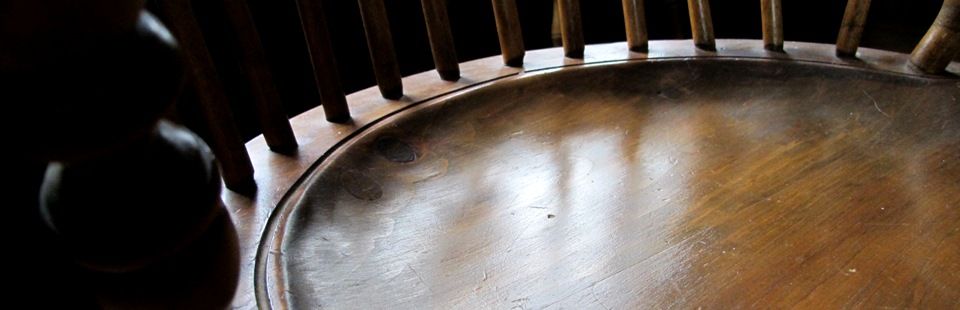
Reproduction Windsor Chair

Finally, a dining room set.

No Power, No Heat.

Our first snow storm and it's aftermath, October, 2011.

Lead Poisoning

Updates to our son's lead levels.

Bit By Bit

My wife's blog on being pregnant, giving birth and raising our first child with all the complications, hardships and joys that life throws our way.

Sunday, April 20, 2014

Parlor Renovation, Part II - Window Sashes

A continuation from Parlor Renovation, Part I.

It was agreed that I would strip the window sashes to save on cost in preparation for the work to be done to our southern parlor window.  It was a simple task (isn't it always?).  I purchased paint stripper, a scraper, a dust suite and a lead vapor rated painter's mask.  I setup my area in the driveway placing a disposable plastic tarp on the pavement, two horses atop and dawned my space suite attire.  I retrieved the sashes from the back porch and while carrying them to my work area, one of the rails loosened and nearly fell off.  Well, there goes stripping them...

Turns out, the bottom rail on one of the sashes was rotted at the joint and had come loose.  My tail between my legs, I called Sunderland and requested his opinion.  He felt that it was an easy fix of a job costing roughly $300.  As usual, I wanted to make sure I was getting the best price.  After he explained what that cost entailed (replacing the bottom rail and re-glazing the three bottom panes).  I told him to never mind the whole window altogether and simply focus on repairing the rot and water issue with the frame.  I sought to replace the window sashes outright.

I searched online and came across Caroline Sly of Ashfield, MA.  She is a one-woman shop and claims to make windows by hand (among other wooden assemblies including stringed musical instruments) and after contacting her, she offered to stop by and show a sample of her work.

Prior to her arrival, we exchanged emails.  We spoke of early expectations and I learned just how affordable she is.  As my readers will recall, I always say that money is a matter of perspective, so what does affordable mean?  Well, if Sunderland Period Homes was willing to repair my one lousy reproduction window sash from the 1960's for $300 plus another $400 to weatherstrip with vinyl/plastic strips both sashes; Mrs. Sly was hand-making TWO sashes, with antique glass from the 19th century and weatherstripping of a similar nature for $425 (un-painted).  $700 to repair one reproduction versus $425 for a new period reproduction.  

I'll take your silence as a nod of approval.  She's a godsend when dealing with a constant barrage of high prices.  Mind you that pieces from Mrs. Sly are a custom one, so what may be of one charge for my home, could be different for yours (meaning, you should contact her for specific applications).  Here is her site: www.CarolineSly.com.

Her work speaks for itself.  Is it perfect, no.  Is it affordable?  For us, yes.  There are little issues I have with her work, details that would annoy me tremendously if Sunderland had done it, especially with his level of pricing.  She gave her opinion with details and listened to our desires.  It took her a week to create the pair of sashes, glaze them and deliver them to our home.  The glazing was still pliable when she dropped them off.

I was hesitant on informing Mr. Sunderland of my purchase.  After all, he is working on our home and has the means and methods of creating windows.  I would not want to offend him by taking business away.  I tried to keep things simple and simply asked that we did not install the weatherstripping on the old sashes and that I'll deal with them later.

But Mr. Sunderland kept on badgering me about the window, that it needs to be repaired or it will not function correctly, etc.   He was right, of course, yet, his pricing is just out of reach for my sanity.  In the end, I relented and confessed the real reason for foregoing the repair of the old sash.  Once my secret plan came to light, Mr. Sunderland really didn't say much.  He didn't seem to mind at that time and I invited him to examine the new sashes. 

Sunderland Period Homes strives for perfection in the details, at least that's the impression.  So, it wasn't until several weeks later that Mr. Sunderland felt compelled to give his full opinion of the sashes.  He examined the window and began pointing out all the inconsistencies in workmanship as well as the structural integrity of the window.  He said that the rebates for the glass were too shallow and that the panes of glass would fall out in time.  He added that the sashes were over tightened while being assembled which warped the sash.  He continued on for a short while, honestly aggravating me quite a bit.  I cannot afford to have Mr. Sunderland do as he pleases on my dime.  I'm not a wealthy person, I'm simply a family man paying my bills with an interest in historic homes.  So, with whatever little extra income we have goes towards our home.  If the expense is too great, something has to give.  I'm not a bottomless pit...

In retrospect (and I'm not an expert) I find it a bit hard to believe that a joiner from the 18th century would have made such perfect sashes by hand with wood sourced from one's backyard that would've passed Mr. Sunderland's critique.  It's been a while since that discussion and I am still annoyed by it.  I'm sure he's also annoyed at me for telling him that he's just too damn expensive for us, literally.

These sashes may not be perfect, but you be the judge.  Do they live up to your expectations?  Here are some closeups as they looked when Sunderland saw them:


The left sash is as Mrs. Sly delivered it, fingerprints and smudges from the glazing process present (so what?).  The right sash was cleaned and prepped for painting.  I think I am satisfied.

Mrs. Sly is due to come back to install the weatherstripping and fitment within our frame.  As of this posting, our agonizingly slow repair is as a result of yours truly having other priorities (a.k.a. LIFE) getting in the way.  As an update can be made, I'll post it up.

UPDATE:
Miscommunication, one of the most annoying things in life.  Between the window sash ordering, scheduling, dealing with Sunderland Period Homes, the lead problems; I must've misunderstood Mrs. Sly when she and I discussed installation.  She was unable to install the window sashes due to age (70+ years to her credit).  So I sit here completely beside myself since the promised windows were delivered without weatherstipping pending installation (hence my assumption of her installing them).  Well at least the price of the window, as is, is still more affordable than a repaired replica.

Wednesday, February 5, 2014

Dining Room Area Rug

With our parlor currently being renovated (very slowly), and there is only one other way to get to the back of our home, our dinning room is getting quite a bit of foot traffic.  I've become concerned that our old floor is being beaten more than required.  On top of that, our toddler has been running around the room playing and wrestling.  My mind goes crazy the level of damage that can be done to these unprotected pine floors.

My wife and I have been on the lookout for rugs locally and from various other online sources.  I came across the "souvenir" shop at Colonial Williamsburg and found the Leaf Green Garden Maze area rug (seen here).  We liked the look of it and as it was designed based upon a sample from Colonial Williamsburg's archive is a major plus.  The manufacturer is Capel Rugs and is constructed of 100% Olefin.  
I know what you're thinking.  What is Olefin?  I had no idea until I looked it up.  It's a synthetically made fiber that has several advantages.  It is abrasion and fade resistant and also resists water & mold.  Hence why this rug can be used both indoors and outdoors.  Cleaning up is much easier than on a "normal" carpet but I can imagine that fluids would pass through it much more quickly than other materials.  

An important note on historic rugs.  From my understanding (which is limited), rugs were of two types in the 18th century, if used at all.  There was the braided type in ovals and circles and then there was the canvas from sails.  Sails were woven canvases of hemp or flax sheets.  Obviously, Olefin would never have been found in an 18th century home (it was invented in the 1950's).  It's woven appearance is similar to a thick canvas, like a sail.  Texture-wise, it takes some getting used to but with it having the appearance of a sail-like material, it fits well with our home's historic details.  Also, there is no pile, just a flat non-fuzzy canvas.

The internet is full of various prices for the same exact item.  I searched and searched and found this source: Brick House Rug Center.  The shipping was free and took less than a week from their warehouse to CT.  It came wrapped in a thick plastic sleeve, but was compressed during shipping/storage and has ripples from the folds.  In time, these should flatten out.  The rug came with a cleaner from the manufacturer as well as a non-slip pad (needed as this rug is slippery on a wooden floor).

And one last bit, the coloring from the seller's site, as well as that of the manufacturer show more green tones.  The carpet I received seems much lighter being a mixture of green and white.  I'm not sure why, with exception to computer screen coloring.  Maybe there was an error in shipment/manufacturing or perhaps this is what it is.  Below is a comparison with the coloring of our pine floors.  The difference is not too far off to make us cringe but is a bit of a let down.


Wednesday, December 25, 2013

Parlor Renovation, Part I

August 4, 2012...

"OK!  I know it looks bad, but it looks worse than it really is.  I swear!"

That's the only thing I could say to my wife when she came into the parlor.  It's only a hole in the wall, right?  A frown, and the look of "what did you do now" was the kindest of greetings one could receive...

From the survey of our parlor, a rubber-cement glued wallpaper could be seen hiding the water damage plaster underneath (thanks to the previous owner).  As I peeled away the God-awful wallpaper, I opened a can of worms....the wallpaper was holding together the damaged plaster underneath.  In my unknowing nature at that time, the "loosened" plaster fell out and I had continued to remove what I had thought was damaged plaster resulting in a gaping hole in our exterior wall.

Before , left:  Rubber cemented (and painted) wallpaper.         After, right:  Wallpaper removed, punky plaster exposed.


Wallpaper removed, "loose" plaster gone (lathe saved) and the window trim removed (some damaged), I found myself dug deep into a pit.  My knowledge was limited, my hopes high.  I wanted to do the work myself, pride took the better of me.  I continued to knock "loose" the surrounding plaster away.  In the end, I was left with an annoyed wife and crushed pride.

More wallpaper being removed, wetted areas are now visible below the window.


Without the knowledge to repair my deeds, the wall sat there for the remainder of the summer, fall, winter, spring... yes yes, and then summer.  I must have sub-consciously buried the plan to have it fixed for each time I said out loud to my wife that I am busy and can't do this or that right now, she would interject and say, "Like the hole in the wall?" It was painful to have to be reminded of my error or lack of ability.

I removed the wall paper entirely, along with the two sashes, sill, molding and punky plaster.  Notice the solid piece of wood at the window sill height that is where the original chair rail would have been.
August, 2013...

I had a plan (in my head).  I needed to learn how to do repairs on my own home yet books only showed vague interpretations of other jobs but I am a visual and hands-on person.  My plan was to contact Mr. Sunderland of Sunderland Period Homes.  I had the idea that since he's employed several talented persons, perhaps I could hire but one to show me how.  I wanted to learn how to do this and that and thought that perhaps I could "rent" one of his carpenters or plasters for a day to show me the ropes.  An email was sent off.

View from the southeast corner of the home towards the west.  The window is just west of our coffin door.  Notice the slight bump that is just below the window.

South exterior wall.
South exterior wall, window and coffin door.
Mr. Sunderland was confused by my questions and request.  He asked to come over and I can surmise that his trip was to evaluate a future job as oppose to a learning experience for the home owner.  We spoke of several topics while he was at our home including making our coffin door functional, adding a chair rail, siding, identifying a possible structural issue below the window... oh, and yes, the window and plaster mess yours truly created.  The idea of instruction was thrown out the window very quickly as Mr. Sunderland was too confused (perhaps on purpose) to follow.  So, we discussed how he would repair the window and bring it to new (along with the aforementioned items).  As I walked Mr. Sunderland to his car, we discussed a budget.  After pricing out how much a new window was from a few sources, to include the sashes and frame, (minus installation) I figured that a repair for such a window would surely not cost anywhere near the estimated $2,000 for the uninstalled package.  Considering our finances, my wife and I decided that $2,000 seemed a reasonable maximum amount to repair that plaster wall, reset the window sashes and stop the water leak.  Mr. Sunderland nodded as if he understood, yet said that it may be a bit more.  It was a one hour chat and an email to follow within the week that blew my mind, and not in a good way.


Here was the estimated total (are you ready for a jaw drop?):  $6,800.00

My mouth dropped open, I even imagine a bit of saliva dribbled out as I was dumb struck.  My wife had to cover my child's ears as, in my delirium, extraordinarily colorful words expelled from my drooling mouth to such extent that my opinion of Mr. Sunderland dropped dramatically.

I emailed/called Sunderland Period Homes to explain to me why it would cost nearly $7,000 to fix a leaky window and patch the plaster?  Here was his response, in layman's terms:

$2,600 is for the chair rail restoration.  The rail had been removed by a previous owner and replacing it would bring the room back to an original appearance.  The cost included the materials and labor which involved scribing the wood chair rail to match the uneven plaster wall along three walls (the fourth being paneled).  I'll pass on a scribed chair rail, saving myself 30% of the estimate upfront.

$600 is for removing paint from the existing reproduction sashes on one window.  Ah, thanks, but I'll spend a few hours over a weekend doing that myself...

$400 is for weatherstripping the two existing reproduction sashes.  What?!  It costs less than a dollar a foot to purchase!  There's no way that labor could be that expensive!

$3,200 is for (quoted from the estimate):

  1. Flash the header window with lead.
  2. Attach wood lathe properly under the window.
  3. Plaster over existing lathe.
  4. Re-install sash and window trim.
  5. Remove exterior storm window.
  6. Strip paint from exterior window frame.
  7. Restore shape of exterior sill.
  8. Remove siding at left, right and beneath window to assess condition of sheathing.
  9. Install new 30 lb. tar paper around and under window.
  10. Install "ice and water" for water proofing around window.
  11. Caulk edges around window frame and re-install siding with rosehead nails.

In addition to the above items, he wrote up an estimate for "custom made interior storm windows" to replace the exterior aluminum units currently installed, restore the clapboard siding and restore the coffin door.  The other estimates combined grossed around $46,000.  All I wanted was to stop the water leak, but at least I can see where Mr. Sunderland's pricing is in other aspects.

I bit the bullet.  I signed a contract with Sunderland Period Homes for the $3,200 + (and yes, plus the outrageous $400 for weatherstripping).  I must seem insane to you, honestly though, I have a reason.  After asking for references, I spoke with a few of his former and current clients.  They all shared one answer.  He is insanely expensive, but he gets the job done right once.  This gave me an idea.  I figured, if I am paying an excessive amount of money for this small job, why not be present, mentally record what would be done and, replicate it on the other 20+ windows that need some sort of repair.  The work will be done for me and I'll be educated in how it's being done by a qualified crew.

My readers, when the job is complete, and time allows, look for a how-to for waterproofing and restoring a leaking 250+ year old window and frame (to be updated in 2014).

Side note (but important):  After the fiasco with my son's lead levels, I decided to take a sample of the underlying paint from our parlor's newly exposed surfaces.

D-Lead test samples.
The test came back negative.  It is assumed that while removing wallpaper, I had inadvertently released this trace amount of lead into the air.  I can rule out this room as being a cause for the lead in my son's system.  See this post:  Lead Poisoning, for the full story regarding lead issues.

Sunday, October 6, 2013

Rice Cakes

They're delectable, aren't they?  Unwrap the plastic bag, pull out this wafer of Styrofoam, take in a sniff of that caramel or that artificial sea salt scent and savor the texture and feeling of eating a rice cake.  

Ok, most of us don't really do that.  In fact, if you were like me, you'd rather reach for any other treat besides flavored rice cakes... unless your a ravenous mouse intent on being an organic flotation device.

Yes, they've returned.  These pesky rodents just love an old home and rice cakes.  Having had rats as pets in high school, my wife (OK, me too) is (are) hesitant on ridding our home of mice using poisons, especially with one and a half children running around.  So, instead, we purchased a mouse trap that takes care of the deed and seals itself upon contact.  No mess, just throw the whole container out.  Much better than the "instant" (as in instant death) chocolate milk-like powdered bags filled with poison that our predecessor left for us to find.  

This past month, while entertaining our son, a whiff of death emanated from the floor boards.  The smell was similar to one of my first posts where a rather large carcass of a mouse (perhaps mouse-rat hybrid) was stuck under the bathroom vanity (What is that Smell?).  The whiff was so putrid that being downwind was enough to make me seek it out.  

I ventured into the basement, trying to sniff out the tell-tale scent.  No luck.  There was no trace of the scent, there was a dried dead mouse, yes, but the strong pungent smell of death was only present in the keeping room above, not in the basement.  After throwing out the dried fuzzy-wuzzy, I brainstormed.

My next thought was that the putrid relative of the dried fiend was trapped in the insulation, much like those discovered previously (Surprise in the Insulation).  I went at it (again).  I took down the insulation that I had replaced.  To my dismay, bay after bay of secure insulation was ripped down in search of that deathly critter.  Again, no luck!  After taking down all the insulation, there was no sign of it!

I returned back to the main part of our home, itchy as all hell, with no discovery to report.  So we sat there, in the keeping room, on our couch, smelling rotting flesh.

Then, it occurred to me.  Could it be possible that a mouse was lurking on the ground floor, crawled into the couch, got stuck, and died?!  Oh how nasty!  Just the thought was making me want to vomit, not to mention, throw out our nearly new couches.  I tore apart the couch.  The smell was there, but not.  It kept coming and going.  I gutted the couch cushions.  Every last bit of polyester stuffing was gone.  Once the couch looked like a deflated balloon, I thought, I would find something, the smell was just that strong.  I used a shopping bag wrapped around my hand as a precaution.  Here's what I found:

A big fat NOTHING!

We could still smell that putrid scent.  At least its not from the basement or the couch.  The wall, however, had the strongest smell.  The wall directly behind the couch, the only wall to have the original windows still in place.  I followed the scent but there was nothing under the baseboard, outside the window or in the window.  

It's been a couple weeks and the smell is long gone.  The corpse was never found.  I doubt the critter awoke like a zombie and left searching for it's next meal.  My best guess is that the rodent was hiding somewhere in the foundation sill when it died.  Either just under the clapboards on the outside or in one of the baseboard plumbing chases that were drilled through from the basement side.  I guess the only comfort is that the smell is gone, for now.


Then come the noises.  Oh, you thought I was done?  No, there are now noises.  Behind the keeping room's fireplace paneling last night, we heard a scurrying.  Yes, a fat mouse had gotten wedged as it was climbing the bricks behind the paneling.  I was able to peer behind the panel but was unable to see anything so I assume he's now relaxing somewhere above.  


Also, at night, while sleeping, sometimes, we hear the furry beast munching on a nut over our heads.  The attic, much like the floor above the keeping room is hollow.  The floors are roughly eight inches plus in depth, a playground for these guys.  I fear that I may have to pull up all the floor boards in the attic, search out any openings up there, put in new un-compressed insulation and reseal.  Then, the same thing for the basement.  I should also go around the perimeter of the home and find any other openings.  I'd really hate to start putting out poison...

Tuesday, August 13, 2013

Nightshade

We've all been taught at some point to be wary of wild berries.  Boy/Girl Scouts teach the basics of wildnerness caution.  Parents who are aware of such things do so as well.  But what if your nature experience is limited, never having becoming one with earth?  Despite the commercials showing Wild Berry Passion as the flavor of the moment, there's nothing flavorful about poison berries.

Several months ago, in glee, my wife and I planted grape vines purchased from a local discount grocery chain.  A few weeks ago, my wife spots grapes growing for the first time.  She becomes quite excited and shares a photo of the newly formed grape to her social media network.


While waiting for our little grapes to ripen, my wife noticed that these "grapes" looked funny.  She accidentally knocked a branch off and tried to save it by placing it in a glass in our kitchen.

Looking closely at the orbs, she searched online for immature grapes with nothing looking like these solid green balls.  Eventually, she realized that this plant is not part of the grapevine where she found it, but instead a part of a deadly poisonous weed called Nightshade.

It's "berries" are jambed full of tiny seeds, one plant can produce 80,000 seeds!  The seed pods and leaves are poisonous.  Some "herbal people" harvest them fort their  "medicinal" properties.  As we're not shamans, we've plucked out as many as we could after discovering their true identity.  They were growing next to the vines of our grape plants so hence my wife's confusion.  In fact, they were found next to our back door, around our rose bushes, by the coffin door and randomly throughout the perimeter of our backyard.

I curse the previous owner for being so lax with her yard maintenance:  free growing poison ivy/oak/sumac and poisionous nightshade should be against the law.  They all spread easily and, with a ripened nightshade looking like small berries in reds and dark blues (green, unrippened), they appeal to children.  With my little guy sticking whatever he can into his mouth to taste, you can imagine our fear with having him in our back yard.

Nightshade, specifically Black Nightshade, causes these symptoms:

Your mouth dries up and your pupils dilate.  You get diarrhea and vomiting along with obvious stomach pains.  Your pulse either sky rockets or plunges and some people go into shock.  Your breathing slows as well.  Next, you get a fever and start to hallucinate (hence the "medicinal" property). Your hands go numb, you get a headache; worse yet, some go paralyzed.  Oh, and your whole body sweats.

Sounds great, doesn't it?

Good news is, these plants are pulled out easily.  Their roots are shallow, wear gloves as a precaution, grab the base of the stem and pull it out.  It may even be better to place a plastic bag over it so that none of the seeds fall off.  Place the plant directly into a covered trash can to ensure the least amount of exposure to others and thrwart birds seeding the yard.  Thoroughly wash your hands afterwards.

I went a step further and warned my immediate neighbors.  They have a child and dogs.  And for my pet chicken owners, Nightshade seems to cause irritation in very small quantities but most chickens seem to know to stay away.  But, in large quantities, it can cause eventual death.