Welcome!

How we came to purchase our home.

WPA Photo

A Works Progress Administration photo offers a glimpse of our home's past.

Reproduction Windsor Chair

Finally, a dining room set.

No Power, No Heat.

Our first snow storm and it's aftermath, October, 2011.

Lead Poisoning

Updates to our son's lead levels.

Bit By Bit

My wife's blog on being pregnant, giving birth and raising our first child with all the complications, hardships and joys that life throws our way.

Tuesday, April 30, 2013

Stone Wall.

Sometimes I get bored.  I'll start one project and become frustrated with how long it is taking to finish, switch to another and at some point in the future, return to the first project (sometimes not).  So when I started to take apart one of our retaining walls, my wife gave me a scared look.  Call it "deer-in-headlights".

My plan for this past Sunday was to take it easy, what with my squished foot.  Thinking of easy tasks, I ventured into the back yard.  On my way out, I passed one of our sad looking field stone walls.  The previous owner, by her own volition, wanted an o'natural look to everything which basically meant a lack of property maintenance.  She loved climbing ivy plants, the type that root into and damage wood and masonry.  This rear entrance retaining wall was covered in ivy, so much so, that it actually hid the collapsed section of the wall.  It was an eyesore.  So I spent the entire day "restoring" it.  My legs, back and every other muscle in my body can attest to it.  There's no "taking it easy" when working with stone.  I am an idiot.

Before:
Mound of English Ivy.  You cannot tell from this photos but there's a beautiful stone wall hidden underneath.


I tore out as much of the rooted ivy plants as I could.  In doing so, I was also removing the stones.  Those ivy plants dug in deep and with the wall a bit disheveled and leaning outward, eventually, I just tore apart then entire south end of the wall.

Rebuilding:
Bit by bit, I reorganized the pile of stones.  Finding the right stone to fit the corner, or face, is not so difficult, just heavy. Basically, the larger flat sided stones are for the face of the wall and any stone that has two flat faces next to each other make a corner.  All other stones are filler, either for leveling the larger back-breaking stones along the face or within the wall to add mass.  Stone dust is a wonderful filler to fill the voids.  It's similar to sand in that it's a fine material, however, it is more coarse and compacts nicely.  In the photos, the stone dust is the grayish colored "sand".  Luckily, it's the same material used to level the brick walkway.  A surplus amount of it was left around the area.  

Layer by layer, large flat faced stones were placed around the perimeter.  Behind the large stones, smaller pebbles and rocks were stuffed in.  Some stone dust was shoveled around the pebbles until the layer was flat (or as flat as came be).  I hand tamped the stone dust to get it compacted and repeated this process for the next layer.


After trial and error, I eventually got the stones to fit just right.  The shear weight of some of these stones made it difficult to continually place, rotate, remove, etc., especially as the wall grew in height.  Now since this wall was already established, I used the bottom most rows and my eye as a guide to keep the wall straight.  Though, if I were to start this wall from scratch, I would've used a reference line.  Two stakes with a string tied between them makes a great guide for laying the first stones.

I ran out of the free stone dust and was about eight to twelve inches short of the walkway elevation.  I used earth for the rest of the fill and it actually worked out pretty well. I threw some grass seed on top to help curb any soil erosion.

After:


A vast improvement to the Before images.  Notice that the stones are now leaning slightly in as oppose to out, making the wall more stable.

I am pleased with the outcome.  It was honestly my first attempt at a field stone wall.  We have another much larger wall that will need some repair in time.  I would also like to install a small two to three foot high wall along the front of our property.  Done correctly, it will last a lot longer than a rickety fence.  I just love the strength and appearance of a stone wall, don't you?
Saturday, April 27, 2013

Brief Visitor, Squished Foot.

A couple weekends ago, I was clearing a brush of poison ivy, a couple trees and other manly landscaping tasks when a Mercedes convertible pulls into my driveway.  Normally, when that happens, the driver is lost and is making a U-turn.  This driver actually got out of the car.  Perhaps this person needs directions?  I mentally put on my "thinking cap".

Speaking in a rather quick pace, the driver introduces himself (and for the life of me I cannot remember his name). He's in a hurry to go somewhere but felt compelled to stop by as he saw me outside.  He knew my name and said that he was from a few houses down (a home that my wife and I had visited while it was on the market at the same time as ours was).  His home is an 1850's blue colored Italianate styled house.  I knew it rather well.  He goes on to say that he was the new owner of it and started to list what he had done recently to it.

I am still in shock that he knew my name and cannot recount all the details of that conversation.  Except one. He pointed to my roof and said that I needed to try this spray that will remove the black algae, lichen and moss that was growing on it.  Bewildered by his sudden appearance and knowledge of me, I began recounting some stupid story regarding my roof, like a bumbling fool.  "He knows my name, who is this guy?" I kept thinking.

Still in shock, he quickly leaves just as he had arrived.  

As I return to my manly duties, I was trying to remember what the product he was explaining was.  Something about "set it and forget it", like that TV infomercial at three in the morning.  My brief visitor proclaimed that the product will help remove the organic growth and save my roof.  I "google-d" what I thought he was talking about in order to help me recall what he had called it.  I saw the name finally and I remembered.  Spray and Forget.

As I wanted to take his warning of roof peril seriously, I visited my local hardware store and searched for the Spray and Forget display.  There really wasn't one, but I eventually found it with an employee's help, hidden in the paint section.  I saw the price and proclaimed an expletive.  Around $40 for a 32 oz spray bottle that you hook to your garden hose. I suppose that if you use it, and it saves you from having to replace your roof prematurely, then $40 is a small price to pay.  I purchased it with that concept in mind and ventured home.

Today, I took out my monster Little Giant Model 26 ladder.  It's a beast and weighs 54 pounds!  Getting it to work just right without reading directions is like poking a stick into a bees' nest.  You know you're going piss someone off... and it's probably yourself.  

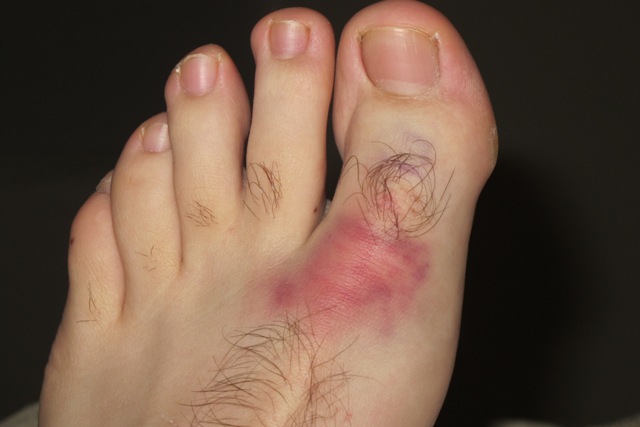
I extended the ladder to it's max height to allow myself to reach the roof.  Then, I realized that I put the ladder in the totally wrong location.  Again, not reading the directions, I had to retract the ladder and pulled the side pins to condense the 54 pounds of aluminum.  That's when it happened.  The ladder slipped, and like a ram rod, fell on my foot.  Though I was wearing boots, steel toed in fact, the ladder's pin-point mass hit just below the tongue and behind the steel toe.  A couple of colorful four letters words were spoken, then I managed to hobble inside.  

My loving wife procured pain killers, an ice pack, some food and water.  I sat on the floor cradling my swollen foot, popped one Advil, ate and drank while holding that iced foot.  I sat there for an hour until I manned up, and after watching a 5 minute video from Little Giant's website, tackled the ladder's relocation and sprayed that damn Spray and Forget roof treatment.

There really is no point to this post except that I felt compelled to share my pain.  I plan on reviewing the Spray and Forget later on, when it's had time to work.  For now, I lay in bed, cradling my gimp foot hoping I haven't broken it.

My hairy foot, 12 hours, one ice pack and 3 Advils later, after being hit by 54 pounds of aluminum.

Thursday, April 25, 2013

Reference Book: Early Domestic Architecture of Connecticut


Here's another exciting reference book that I've come across.  Early Domestic Architecture of Connecticut by J. Frederick Kelly.  The previous owner had left it for us in the home though I don't believe she used it much, more like she kept it around as a coffee table book.  Regardless, this paperback book is an in-depth look at 17th and 18th century architecture.  Written initially in 1924, with reprints in the 60's and later decades.  For any true colonial home owner, this book is a must have.  

Inside this wonderful collection of photos and drawings are formal descriptions similar to a thesis in language.   However, getting past it's formality, the information contained herein is vast.  You want to know how clapboard was made and installed or perhaps why windows were made a certain way in a home of the 1600's versus the late 1700's.  Perhaps it's the interior paneling that you are seeking, or even still, the entire frame work of our homes including the different joint types.  If you're a lover of these homes, the information within is thought tantalizing.

As of this post, Amazon.com is selling Early Domestic Architecture of Connecticut for around $23 (and qualifies for free shipping).  Google books has a sampling of pages with several images, check it out here

Wednesday, March 6, 2013

The Perfect Fire Starter.

We've had our wood burning stove for a year now.  Although I'd like to claim that I'm all knowing, I've been guessing at how to start the fire in our stove given the quick intro by the salesman as well as years of watching my father burn everything he could to start his little stove.  It would take me an hour or more before it reached a temperature hot enough to actuate the on-board blower.  Never realizing that I could be at fault (how could I be?) I was assuming that maybe there was a downdraft in the chimney or some other excuse.

That was until I searched online for hints at starting a fire.

Generally speaking, fire needs three things to exist.

1.  OXYGEN.
2.  HEAT.
3.  FUEL.

Seems simple enough until you follow that recipe without much to show for it.  I would stick a couple of twigs, lots of old newspaper and two small logs into our stove, light the paper with a lighter and wait for one, sometimes two hours before feeling any real heat emanate from the stove.  I had the heat from the lighter, the newspaper and wood bits for fuel and finally, oxygen was there as I kept the door open.  It didn't make sense to me why our stove wasn't working very well.

Several weeks ago, I discovered something.  There are more details to this three ingredient recipe.  And no, I don't mean add a gallon of gasoline, that's just insane.  It's more about how everything is physically arranged and the amount of oxygen being brought into the stove that matter.  It's not so much a 1:1:1 ratio.  The more O2 that can be given to the fire, the stronger it burns.  If you randomly stick a bunch of paper into a stove with some wood and light it, the paper will burn quickly sucking up most of the O2 and not allow the wood to catch on fire.  The twigs that I used as kindling were not large enough to produce the necessary heat to ignite the larger logs.  This left me with lots of smoke and no heat.

How you arrange the kindling, the type and size of it and the stages of burn will either help you or burn you.... (yes, the pun was intended).  So, after a long winded introduction, here's my secret recipe to get a large stove working quickly:

1.  Make your own kindling.  Our local grocery store sells a bundle of kindling for $6 per a pack of 16 sticks of dried wood.  You already have dried wood from your wood pile.  Why waste the money?  Use a hatchet or an ax/maul and split the already dried wood into slivers.  Each sliver should be no bigger than an inch square.  They do not have to be perfectly shaped.

2.  The night before you plan on making a fire, bring some wood from your storage pile indoors.  The coldness of winter will make it harder for the log to ignite if left outside.  It's core is too cold to catch fire.

3.  Collect a few sheets of newspaper.  Never use shiny, wax or plastic-like paper.  Take one sheet at a time and fold it in half, then crumple it into a tube and twist it to make it as dense as possible, like a cigar.

4.  In a clean stove (doesn't have to be perfect), place three bits of kindling across the bottom.  Place the pieces of twisted newspaper between each piece of wood kindling.


5.  Make a second layer similar to the first with the wood rotated 90 degrees to the first layer.  Place the twisted roll of newspaper in-between the kindling like the first.


6.  Now a third layer like the first layer.  This one should be 90 degrees turned to the second layer or parallel to the first layer.  No newspaper is required from here on wards.  A fourth layer of kindling may be added if you have a large stove.

7.  Pick a small split log and place on top.  If there is bark on it, make sure that the bark is facing away from the kindling.

Four layers of kindling, three sticks per layer, 12 sticks used.  Cost?  Pennies, if that.


8.  Light one of the bottom twisted newspaper rolls.

9.  Slightly close the door on the stove leaving about an inch open.  Make sure the damper and air control are fully opened.

Top Arrow (pulled out) - Damper fully open.
Bottom Arrow (pushed in) - Air control fully open


10.  Wait and watch.  Within a few minutes, you'll have a bonfire.  With my massive stove, in less than 30 minutes, I was at operating temperature.  Notice the door is slightly open.

Fire Start Time:  8:29 AM (T = 0 Minutes)


T = 5 Minutes.  Note the thermostat sensor is the gray colored plate on the bottom left of the stove.


Blower On, 8:51 AM (T = 22 Minutes)


Once the fire becomes established, poke and add more logs, close the door and damper   Allow the fire to grow and adjust the air intake to control the fire.

Now you're probably thinking, "Gee, 30 minutes to start a fire is a long time."  Yes, I agree.  The time is more for the thermostat controlled blower to actuate.  The fire was well established after 5 minutes as the above photo attests to.

I am not too keen on the thermostat for the blower.  As far as I can tell, there's no adjustment for it.  It turns the blower on well after the fire has established, yet stays on well after the air leaving the blower is cold.  I'll have to figure that one out in time.

Either way, there you have it.  A sure-fire way (haha) to have a strong fire producing heat.

Thursday, February 28, 2013

Oven/Range Repair

My wife and I had a pretty rough weekend when our little one was ill.  After getting home from the doctors, having not eaten much since dinner the previous night, we were scrounging around our empty refrigerator for lunch.  We found a box of "Frozen Fish Sticks" in the freezer and salivated due to our hunger.

While my better half was taking care of our little one, I went to the kitchen, preheated the oven, got the rack out and loaded the frozen "mystery meat" and french fries (everything tastes better with french fries) onto the pan and into the oven.  Within 20 minutes, the oven was smoking.  I thought perhaps a fry had fallen and burned, nothing more.  We ate our food and that was that.

Dinner time came and my wife wanted to make turkey and stuffing... love it.  I'm working on our computer in the neighboring room while my wife slaves over the stove.  She has the oven pre-heating while preparing the raw turkey.  That's when I hear, "STEVE! THE OVEN IS ON FIRE!"

"Holy S&#T!"  I ran into the kitchen to see an orange glow turning bright white emanating from our oven.  Sparks were flying about.  I turned off the oven and the glow subsided for a few seconds but continued to spark.  I stupidly thought, "Gee, that would make a cool picture...", not really thinking of an electrical fire being serious.
Baking element sparking, notice the upside-down metal measuring cup used as a support, courtesy of the previous owner.

Once my momentary stupidity gave way to reason, I ran into the cellar and hit the breaker for the oven.  The glow went away and the sparks ceased.
Side note:  The reason for the sparking continuing after I turned off the oven was because the electrical heating element is powered by two wires.  Each wire provides 120 volts to the baking element.  When the oven is turned on, the element receives power from both wires, equating to 240 volts.  When it is off, the element still receives power but from only one wire, being 120 volts.  Hence, why it was necessary to shut off the power at the electrical panel.
Back when we had our closing on our home, the owner at that time gave us a letter where she wrote us, among other things, that one of the stove's burners no longer work.  Being a glass top cooking surface, she was told that she'll have to replace the entire stove/range unit.  We were initially annoyed by this but have been living with it since our move in.  After all, three out of four isn't so bad.  Now with the baking element ruined, and we haven't the funds to spend on a new stove, I began looking into fixing the 15 year old appliance.  

I went to my local "big box" store looking to find advice and parts but I was told that it is IMPOSSIBLE to replace an element on a glass top stove; that we would have to replace the entire glass top and it's extraordinarily expensive.  The reason being that, according to the sales associate, it's a "sealed unit".

LIES!  Yes, the glass top by itself is expensive, but the burner elements are far more affordable in comparison.  My stove is a late 1990's Maytag Magic Chef model 5889VV, a smooth glass top electric stove.  The following is how I managed to avoid buying a brand new stove and make cost effective repairs instead.

I take responsibility for my own actions, not yours.  Electricity is nothing to play around with.  It should be respected as should your wallet.  If you do not feel comfortable with electrical repairs, please hire a professional.  Always make sure the appliance is unplugged or the breaker is OFF when working on any electrical component.

I did some digging online.  I found a few videos and a couple of write ups, nothing that matched my exact style of oven/range but they did give me some insight to the procedure.  Most of the videos stated that there are two screws securing the top frame holding the glass surface to the main body.  These two screws are located under the front lip accessed by opening the oven door and looking beneath the controls.  Once removed,  the top frame can be opened like a car's hood.

My stove had two screws just as the generic video described.  Unfortunately for me, these two screws did nothing to allow the top to come off.  So I did what any frustrated manic "handy man" does.  I took a pry bar and pried the cover off.  I was gentle, I promise.

The top was re-movable if pried; I was cautious as it is glass.  I used a lever braced along the front edge of my counter and gently pulled the top towards the front.  I tried this on both sides.  Eventually, the top was now about a half inch from it's starting position.  I took a flashlight and peered in the gap between the top and the body.  There were two metal clips holding the top down.  I gently pried again on one side, loosening the clip on that side, then again on the opposite.  The top was now free to open.

It wasn't until after I had opened the glass top that I realized how it was installed.  For a technician to remove the top, he/she would've had to pull the entire stove forward away from the wall, accessing the rear panel.  On the top of the rear, at each corner were two recessed screws that secured the top in place (THAT'S where they are!).  I also noticed that my particular stove was built into the cabinets, taking it out would've been impossible without destroying what the previous owner claimed were "custom cabinets".  Luckily, I did not damage the stove or the particle board "custom" counter top in my macho move to open it up.


After detaching the power feed and ground, the cover is off, on the floor upside-down.  Each element casing is exposed with all applicable wiring view-able   


I unscrewed the two screws securing the known faulty element, turned it over and discovered why it wasn't working.  Seems that the coil had broken as the dark burnt spot testifies.


Now, if I can get this far, with the detached element in my hands, why can I not simply buy a replacement?  So I did.  I searched for a few hours to find the most affordable price.  One vendor had a steal of an asking price, but asked for my first born in shipping.  Continuing my search, I eventually came to PartsDr.com.  Their pricing was the most cost effective for us (taking into account their shipping of course).  And as usual, no, I have not received any monetary discount for having their company on my blog.

We needed two parts:  The Bake Element and the 6 inch Surface Burner Element for our Magic Chef.

The parts cost us:
Bake Element                  $16.99
6 inch Surface Burner Element $44.99
                   Subtotal:  $61.99
                   Shipping:   $6.99
                   Total:     $68.97

Delivery was rather quick as well as I received both components three days after ordering.  Once in hand, both parts are a simple plug 'n play installation.

The element has a series of wires connected to a ceramic module extending from the side.  Each wire's terminal is labeled a specific number.  I unplugged one wire at a time, to ensure I was connecting it to the correct terminal on the new element.  Though both elements looked exactly the same, they were not.  The numbers on the module were in a different location on the replacement element.  Matching 1a to 1a, 2a to 2a... etc. was critical.

Once all the wires are connected to the new surface burning element, I cleaned up the area with a vacuum, secured the element onto the top frame and reassembled the top onto the stove.  Next, the oven's baking element.

This one was much simpler to install.  Ensure the power is off, open the oven and remove the wire shelves.  There are two screws securing the baking element to the rear of the oven.  Unscrew them and gently pull the element towards the front of the oven.  As you pull, the connected wire will become visible.  Use a pair of needle nose pliers to gently rock the wires off the element.


Here are the two baking elements side by side.  The new one is on the left (notice the standard supports for the element on the left compared to the recycled metal bowl on the right):


Installation is reverse of the removal.  Ensure both wires are firmly connected to the baking element and screw in the two screws to the rear of the oven.  Head to the breaker box and switch the oven on and test.

DONE!

Side note:  Do not assume that fixing the oven (like new) on your wife's birthday as a birthday gift will make her happy.  Appliances and wives' birthdays do not mix.